
Read Time: 8 min
A concrete driveway is one of the highest-value improvements you can make to your property — but only when it is installed correctly from the start. A poorly prepared base, the wrong concrete mix, or inadequate drainage planning leads to cracking, surface scaling, and costly repairs within just a few years.
In Central Missouri, freeze-thaw cycles and clay-heavy soils put extra stress on driveways. That means site preparation and material selection matter more here than in warmer, drier climates — and cutting corners on either will cost you significantly down the road.
This guide covers what goes into a durable concrete driveway, what to expect from the installation process, what decorative options are available, and how to choose the right driveway pouring contractor for your property.
A properly installed concrete driveway lasts 25–30 years with minimal maintenance — but only if the base preparation, mix selection, and curing process are done right from day one. [1]
Key Takeaways:
A long-lasting driveway comes down to three things: base preparation, concrete mix quality, and proper curing. Skip any one of them and the other two do not matter.
Base preparation is the step most homeowners never see, which is exactly why it is the most important one. The subgrade must be compacted to a consistent density so the concrete slab has uniform support beneath it. If one section settles more than another, the slab cracks — not because the concrete failed, but because the ground under it moved. In Central Missouri’s clay soils, this step deserves extra attention because clay expands and contracts more than gravel or sandy soils. Proper site preparation is critical here.
Concrete mix selection determines how well the slab holds up under heavy vehicle traffic and temperature swings. A standard residential driveway uses a minimum 4,000 PSI mix. Higher-traffic areas or commercial applications call for 4,500 PSI or above. The mix also needs proper water-to-cement ratios — too much water weakens the final slab regardless of the base PSI rating. [2]
Proper curing is what most DIY attempts get wrong. Concrete does not dry — it cures through a chemical process called hydration. Rushing it by letting the surface dry out too fast creates surface cracking and a weaker slab. Keeping the surface moist or covered during the first 7 days significantly increases final strength.
Before a single yard of concrete is poured, the site needs to be properly excavated and graded. This work determines whether your driveway sheds water or holds it, and whether the slab stays level over time.
Clearing existing material is the starting point. Any existing pavement, vegetation, root systems, or soft organic material must come out. Leaving organic material under a slab creates soft spots that lead to settling and cracking as the material decomposes.
Grading for drainage is where the engineering happens. A properly graded driveway slopes away from your home or building at a rate of roughly 1–2% (about 1/8 inch per foot) so water flows off the surface and does not pool against your foundation. In flat lots, this sometimes requires bringing in fill material or creating a crown in the center of the driveway.
Compacting the subgrade creates the stable platform the slab sits on. Most residential driveways need 4–6 inches of compacted gravel base on top of the prepared subgrade. In areas with especially soft or expansive clay, that base depth increases. Skipping compaction is the single most common cause of premature driveway failure.
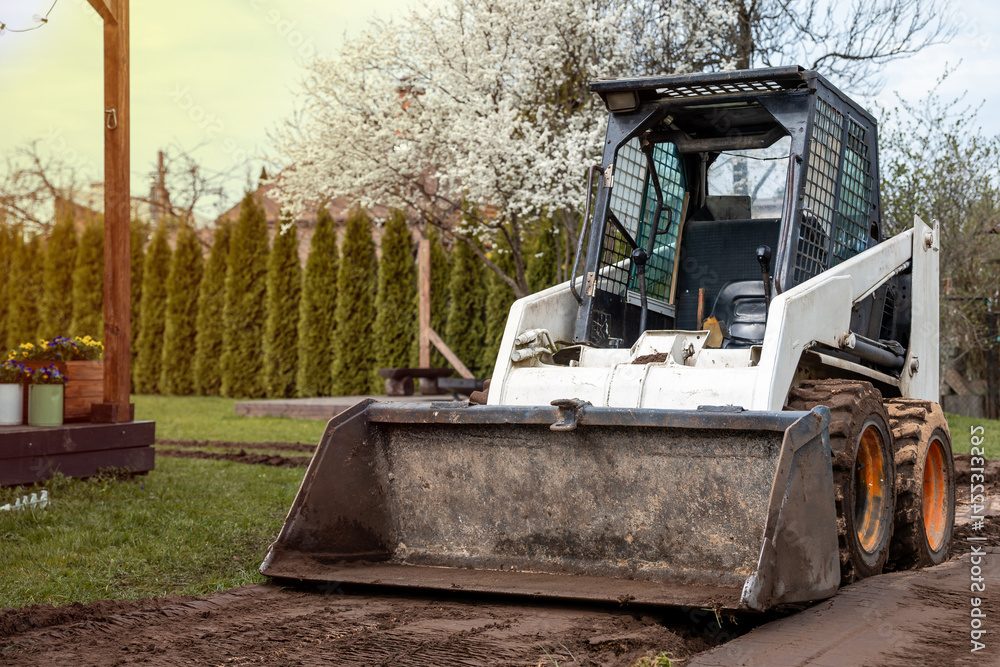
The right equipment makes this work faster and more precise. Bobcat work, grading, and material hauling are all part of the excavation services process — not separate jobs.
Understanding the timeline keeps you from accidentally walking on fresh concrete or driving on a slab before it is ready.
Form setting happens before the pour. Forms define the shape of the slab and hold the concrete in place while it cures. For driveways, control joints are cut or tooled into the surface during this stage — these are the deliberate lines you see in finished concrete. Control joints give the slab a place to crack if it does crack, keeping those cracks small, straight, and out of the middle of the driveway surface.
Pouring and finishing typically takes one to two days for a standard residential driveway. The concrete is placed, screeded level, and then finished with the appropriate surface texture — either a broom finish for traction or a smooth finish for decorative applications.
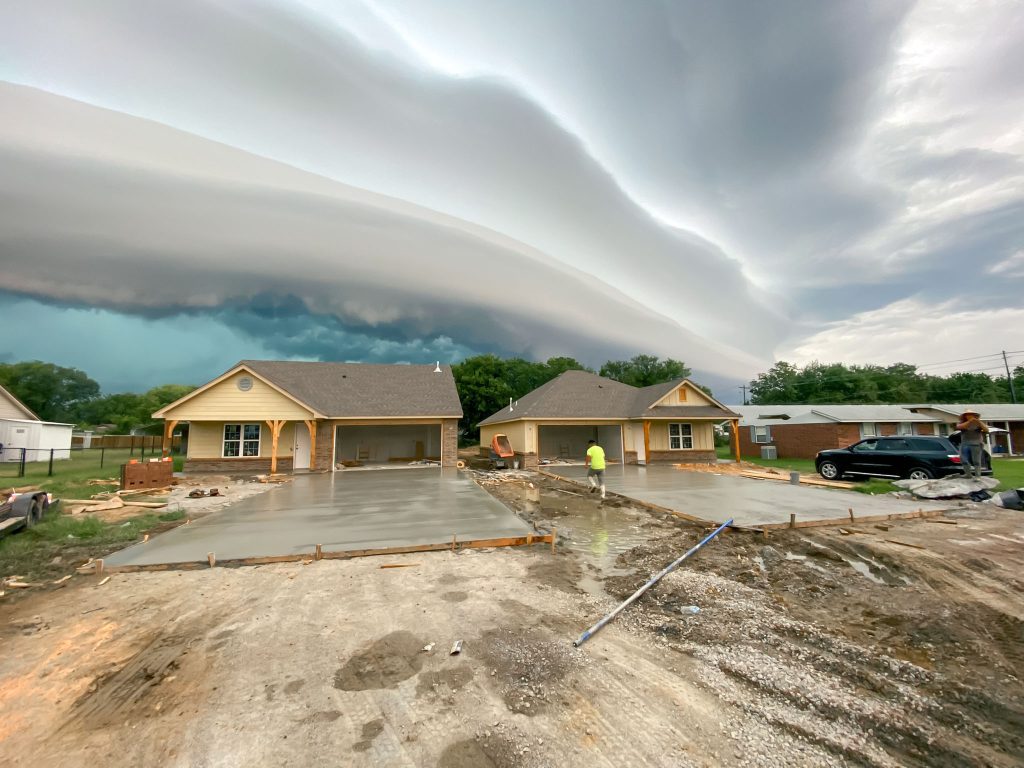
Curing time: Forms are removed after 24–48 hours. Light foot traffic is generally safe at 24 hours, but keep vehicles off the slab for a minimum of 7 days. Full structural strength — the 28-day cure — is when the concrete reaches its rated PSI. Driving heavy equipment or delivery trucks over a new slab before 28 days risks surface damage even if the concrete feels hard.
Decorative concrete gives you the look of stone, brick, or tile at a fraction of the material cost — with the same durability as standard concrete underneath.
Stamped concrete uses patterned mats pressed into the surface before it fully cures. Common patterns include slate, cobblestone, flagstone, and brick. Color is added to the mix or applied as a surface release agent during stamping. The result is a textured, colored surface that mimics natural materials and holds up to vehicle traffic.
Colored concrete without stamping gives you a uniform color across the surface. This works well for homeowners who want a cleaner, modern look without a heavy pattern. Both integral color (added to the mix) and surface-applied color hardeners are available.
Exposed aggregate finishes remove the top layer of cement paste to reveal the stone aggregate inside the mix. The result is a naturally textured, slip-resistant surface with a speckled appearance. This is a popular choice in Central Missouri for driveways where slip resistance is a priority.
All decorative finishes require sealing every 2–3 years to protect the color and surface from UV exposure and freeze-thaw cycles. Skipping sealer shortens the life of the decorative finish significantly, even if the underlying concrete stays structurally sound.
Our process is straightforward, and we keep you informed at every stage.
The right contractor brings the right equipment, the right experience, and honest communication. All three matter.
Equipment matters because site work is not a hand-tool job. Proper excavation, grading, and base compaction require mechanized equipment — a bobcat or skid steer for moving material, a plate compactor for subgrade work, and a power screed or float for finishing. A contractor working without the right equipment produces inconsistent results regardless of how experienced they are.
Local experience in Central Missouri is a specific advantage. A contractor who has worked in this region understands the clay soil conditions, the frost depth (typically 18–24 inches in central Missouri), and how to design drainage for properties that sit in low-lying areas near creeks or floodplains. [3] These are not details that transfer from a different region. Learn more about our team and experience.
Clear, upfront communication is non-negotiable. Before work starts, you should have a written scope, a clear timeline, and a price that does not change unless the scope changes. Any contractor who is vague about timeline or reluctant to put things in writing is a risk.
Check reviews, ask for references from jobs in your area, and look at photos of completed work before committing.
Concrete driveway installation in Central Missouri typically runs $6–$12 per square foot for a standard residential driveway, depending on the factors below.
Project size is the most straightforward factor. A standard two-car driveway is roughly 400–500 square feet. Larger driveways cost more in materials and labor, though the per-square-foot rate often decreases slightly on larger projects because setup time is proportionally smaller.
Site conditions affect the excavation scope. A flat lot with easy access costs less to prepare than a sloped lot, a property with poor drainage, or a site that requires significant material hauling. These are not extras — they are real variables that change the amount of work involved.
Decorative finishes add cost. Stamped concrete adds $4–$8 per square foot above a standard broom finish. Colored concrete and exposed aggregate fall in between. Sealing is typically an additional line item but is worth budgeting for from the start.
Material and delivery costs shift with market conditions. Concrete prices in central Missouri fluctuate with fuel costs and regional supply. We factor current pricing into every quote so you get an accurate number, not a six-month-old estimate.
Every job is different. Request a quote and you will have a specific number for your specific property within a short turnaround.
A concrete driveway is a 25-year investment when it is installed right — and a recurring expense when it is not. The difference comes down to who does the work and how they approach the site preparation, mix selection, and curing process.
Concrete driveway services from Hoover’s Bobcat Service LLC handle the full scope: excavation, grading, forming, pouring, and finishing. We work within roughly two hours of Versailles, MO, and we know Central Missouri’s soil and weather conditions from the ground up.
Call us at (573) 569-5789 or reach out through our contact page to get a clear, honest quote for your driveway project. We will get back to you fast — that is how we operate.
Visible cracks wider than 1/4 inch, surface scaling or flaking, uneven sections where one slab panel has shifted relative to another, and water pooling on the surface rather than draining off are all signs of a driveway that needs attention. Address cracking early — small cracks let water in, and freeze-thaw cycles widen them quickly in Missouri winters.
A properly installed concrete driveway lasts 25–30 years in Central Missouri with basic maintenance. Poor base preparation or inadequate drainage cuts that lifespan significantly, sometimes to under 10 years. Regular sealing every 2–3 years and prompt crack repair extend the surface life toward the upper end of that range.
Inspect the surface each spring after the freeze-thaw season ends. Clean the driveway with a pressure washer to remove debris and staining. Seal the surface every 2–3 years with a penetrating concrete sealer — this protects against moisture intrusion and surface scaling. Repair small cracks with a concrete patching compound before they widen. Avoid applying rock salt for ice control; it accelerates surface deterioration. Sand is the better choice for traction in winter.
Technically yes, but the practical answer is no for most homeowners. Correct site preparation requires mechanized equipment that most people do not own or know how to operate. Mistakes in grading, compaction, or mix water ratios are not fixable after the concrete cures. Hiring a professional significantly reduces the risk of a slab that fails early and needs full replacement.
Driveway size, site conditions (slope, drainage, access), concrete mix specification, decorative finish selection, and current material costs all affect the final price. In Central Missouri, expect $6–$12 per square foot for a standard residential driveway. Decorative finishes add to that baseline. The best way to get an accurate number is to request a site-specific quote.
Stamping, coloring, and exposed aggregate finishes are the most effective options during installation. For an existing driveway, applying a quality concrete sealer restores surface sheen. Adding landscaping borders along the driveway edges frames the surface and improves the overall look of the approach to your home or building.
Clean the crack area thoroughly to remove any loose material, then fill small cracks (under 1/4 inch wide) with a self-leveling concrete crack filler. For cracks wider than 1/4 inch or cracks that run along control joints and show vertical displacement between panels, call a professional — that level of movement indicates a base issue, not just a surface issue, and patching the top will not solve the underlying problem.
Keep vehicles off the slab for a minimum of 7 days after pouring. Passenger cars and light trucks are generally safe at 7 days under normal curing conditions. Heavy trucks, delivery vehicles, or construction equipment should stay off the surface for the full 28-day cure period. Driving on concrete before it reaches adequate strength causes surface damage that cannot be repaired without grinding or overlay.
Serving Versailles, Jefferson City, Eldon, Warsaw, Clinton, Lake Ozark, Camdenton, Rocky Mount, Sunrise Beach, and surrounding Central Missouri communities.
Additional resources and tips are available on our blog.
Sources:
[1] American Concrete Institute – for concrete driveway lifespan and durability standards
[2] Portland Cement Association – for water-to-cement ratio and mix design guidance
[3] University of Missouri Extension – for frost depth and clay soil conditions in Central Missouri
| Website By ZIMMERMAN | Privacy Policy